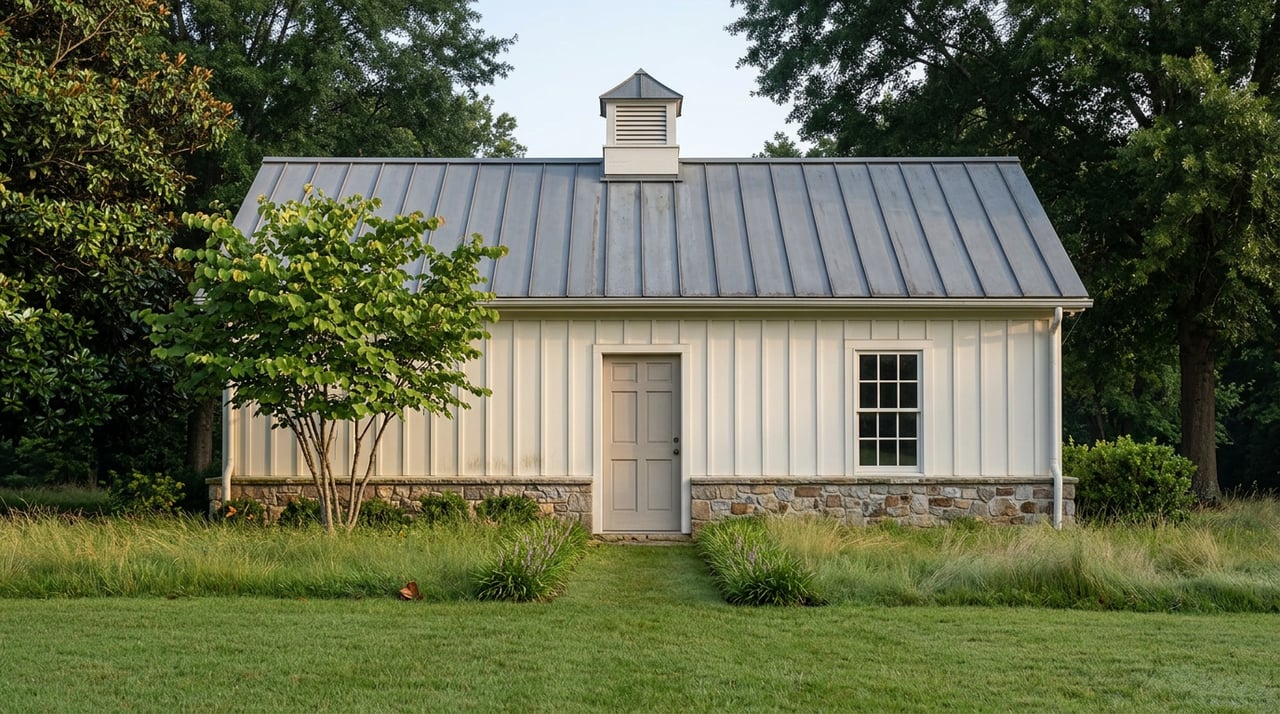
At Waters Edge, the Barn Runs the Week and the Pavilion Just Hosts the Party
August 13, 2026
August 13, 2026
By 7 a.m. on a summer Tuesday, two entirely different mornings are already underway behind the same gate. On one side of the property, someone backs a pontoon down the community boat ramp, coffee balanced on the console, aiming to get out before the lake fills up. A few hundred yards away, down a private road lined with black board fencing, a neighbor is already in the barn aisle checking a water bucket before turnout. Neither one has run into the other yet this week. By the weekend, they probably will, and it won't be at the pavilion.
Waters Edge on Lake Oconee has always been sold as a hybrid: lakefront homes and horse property sharing one HOA, an arrangement that's genuinely uncommon on this stretch of the lake. What the listing photos leave out is which half of that hybrid actually sets the community's pace. The lakeside pavilion gets the sunset shots. The equestrian center gets the calendar.
Anyone who has spent time here knows the split isn't cosmetic. Buyers are routinely told to figure out which side of Waters Edge they're actually choosing before they choose a lot, because the two lifestyles run on different clocks and different price logic. Lakefront value comes down to cove position, dock depth, and water exposure. Equestrian value comes down to acreage, fencing, and barn condition.
A recent example makes the equestrian side concrete: a listing at 108 Walking Horse Lane put a 7-stall barn, four-board fencing, and a 4-acre stocked pond on 12.28 private acres, with the community's riding trails running past the property and the same boat ramp giving lake access a short drive away. That's not a lakefront lot with a horse as an accessory. It's a working horse property that happens to share a subdivision with a marina.
| Lakefront homes | Equestrian estates | |
|---|---|---|
| Morning ritual | Dock check, boat prep, coffee on the water | Turnout, feed, barn chores before the heat |
| Value driver | Cove vs. open water, dock configuration, depth | Acreage, board fencing, barn condition |
| Shared infrastructure | Community boat ramp and day dock | Riding and walking trail system |
| Weekend anchor | Lakeside pavilion gatherings | Barn show days and clinics |
The two groups share a gate, a set of private roads, and an HOA newsletter. What they don't automatically share is a reason to run into each other, which is exactly why the barn's calendar matters more than the brochure lets on.
The equestrian center inside Waters Edge isn't a paddock with a few backyard ponies. It's a full boarding and lesson operation: a lighted 150-foot by 250-foot arena with jumps, a training-size dressage arena, a solid round pen, roughly 30 acres of pasture, a 13-stall barn, eight turnout paddocks, and a climate-controlled club room with lockers. Lessons run private, semi-private, and group. Horses come in for training, breaking, and rehab. Students ride on a regular show schedule.
That last detail is the one the marketing copy skips past. A pavilion hosts an event when someone books it. A show schedule repeats. It gives the neighborhood a predictable rhythm the same way a marina's Saturday morning traffic does, except this one runs on horse time instead of boat time. Neighbors who don't own a horse still end up learning the show dates, because half their street disappears to a competition on those weekends.
One recommendation for the facility on an equine services directory put it plainly, calling the clinics, trails, and facilities "second to none" and the barn "unrivaled from any barn on the Lake area." That's not a marketing line. It's a boarder talking about the thing that actually structures their week.
Family life at Waters Edge runs through the barn too, and not just for the adults. Summer horsemanship camps for kids check in at the equestrian center's own café, the Roany Pony, where campers sign a waiver, then spend the week learning horse care, safety basics, and beginner riding technique. It's a small detail, but it's the kind that tells you where the community's kids actually spend their summer mornings, and it isn't the pavilion's playground.
Not every resident wants the same barn experience, and Waters Edge quietly accommodates both ends of that preference. Alongside the larger commercial operation, a smaller full-board stable inside the community keeps only up to six horses at a time in common turnout, built around a natural-care philosophy rather than a packed show barn. It's the difference between boarding at a facility built for lessons, clinics, and competition, and boarding somewhere built to feel like six horses sharing one quiet pasture.
That choice, big barn or small stable, is the kind of decision that only makes sense once you already live here and have picked a side. It's also proof that the equestrian side of Waters Edge isn't a monolith. It has its own internal culture, the same way the lakefront side splits between residents who want open-water docks and residents who prefer a sheltered cove.
The place these two communities actually overlap isn't a clubhouse. It's the physical infrastructure that runs through both halves of the property: a riding and walking trail system that follows the same board-fenced private roads used for evening dog walks, tying back to the community boat ramp and day dock that both lakefront and equestrian residents use to get to the water. A rider heading out for a trail loop and a family walking down to the dock end up on the same stretch of fence line more often than either group ends up at a scheduled pavilion event.
That overlap is worth knowing if you're already living here and wondering how to actually meet the other half of your neighborhood. The pavilion is for the parties everyone already knows about. The fence line is where the two clocks sync up without anyone planning it.
The takeaway isn't that Waters Edge has horses and a lake, which every listing already tells you. It's that the horses come with their own working calendar, one with a show schedule, camp sessions, and daily barn traffic that shapes the neighborhood's rhythm as much as any lake holiday does. If you're new here, or you've been here a while and haven't made it past the gate on Waters Edge Drive, the Waters Edge Owners Association site and the equestrian center's own booking page are the two places to actually see what's on the calendar this month, not the pavilion invite list.
Leslie Clark has spent her career inside communities like this one, where the real value of a property depends on understanding which side of the gate you're buying into and how the two halves actually function day to day. If you're weighing a lakefront lot against an equestrian estate at Waters Edge, or trying to figure out which boarding option fits your horses and your life, that's the kind of local read Leslie Clark built her practice on. Schedule your free consultation and get the version of this market that doesn't come from a brochure.
Stay up to date on the latest real estate trends.
With my extensive knowledge and commitment to providing only the best and most timely information to my clients, I am your go-to source for real estate industry insight and advice.